

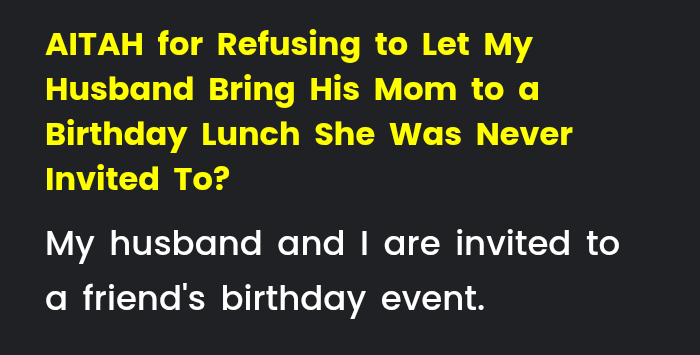
A wife finds herself at odds with her husband after he insists on bringing his visiting mother to a friend’s birthday lunch, despite the gathering being planned for a specific group of friends and their partners.
While she worries that bringing an unexpected guest could put the hosts in an awkward position, her husband feels she is being unnecessarily harsh about including his mom.
The disagreement soon forces the couple to reconsider how they handle family, invitations, and social boundaries.
















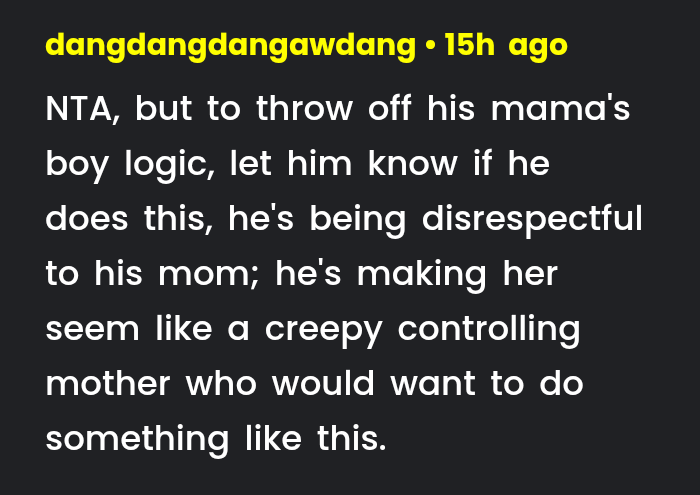
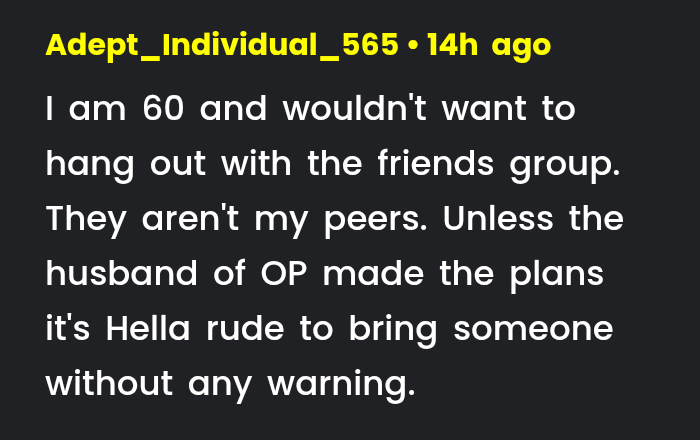
The situation quickly sparked a debate over whether the wife was right to set a boundary or whether she was being unnecessarily rigid about her husband wanting to include his mother.
Some readers may sympathize with the husband’s desire to introduce his mom to their friends, while others may feel that bringing an uninvited guest to a private birthday gathering crosses a basic social boundary.
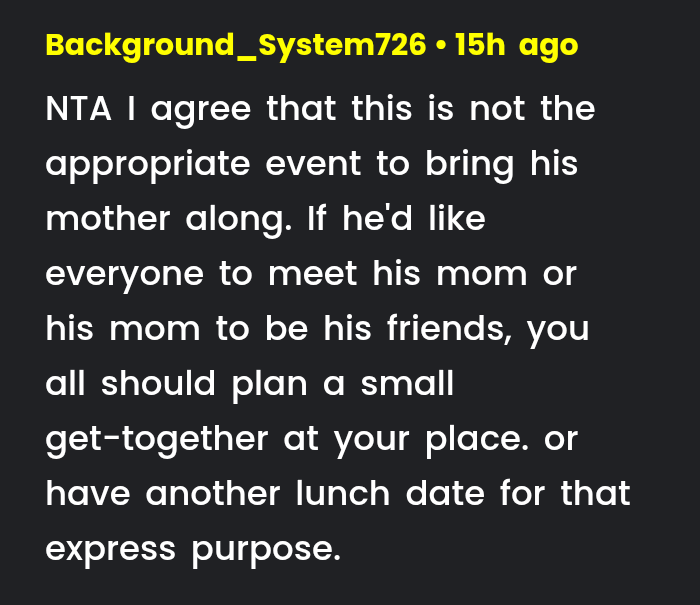
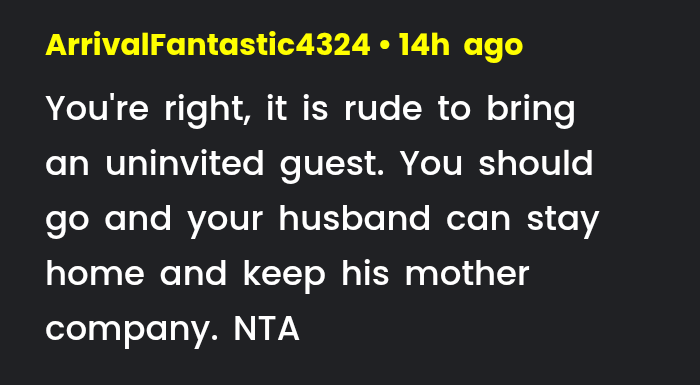
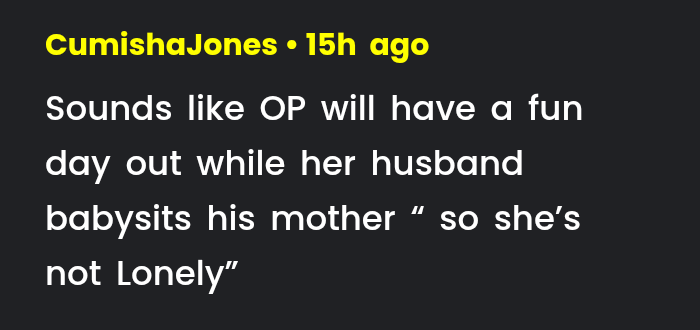
Here’s what commenters had to say about who was really in the wrong.
Check The Comment Section Below



Detailed Analysis
1. The Invitation Was Intended for a Specific Group
The couple had been invited to a friend’s birthday event that followed a familiar pattern: six friends and their respective partners would have lunch together before spending time together afterward. This detail matters because it was not described as a large, open-ended party where guests could freely bring additional family members.
The wife therefore viewed the invitation as being specifically for the people who had been invited. From her perspective, adding another person without checking with the hosts first could cross a basic social boundary.
2. The Mother-in-Law Was Visiting
The situation became complicated because the husband’s mother was visiting at the same time as the birthday celebration. The wife suggested taking her mother-in-law to the husband’s sister’s house so she would not be left alone while the couple attended the event.
This suggests that the wife was not simply trying to exclude her mother-in-law. She was attempting to find a practical arrangement that would allow the couple to keep their existing plans while making sure his mother had somewhere to go.
3. The Husband Wanted His Mother Included
The husband’s position was also understandable. His mother was visiting, and he apparently wanted to introduce her to his friends rather than leave her elsewhere while he attended the birthday celebration.
He may have believed that his friends would be happy to meet her and that having one additional person at the lunch would not be a major issue. His intentions do not appear malicious; he simply viewed the situation differently from his wife.
4. The Wife Was Worried About the Hosts
The wife’s biggest concern was not necessarily her mother-in-law herself. She was worried about the position the hosts would be put in if the couple arrived with an unexpected guest.
If the hosts had planned the seating, food, reservations, or activities around a particular number of people, an additional guest could create practical difficulties. Even if they were uncomfortable with the arrangement, they might feel pressured to say yes rather than appear rude.
This is why asking permission beforehand would have been very different from simply bringing the mother-in-law along.
5. Age and Cultural Differences Added Another Concern
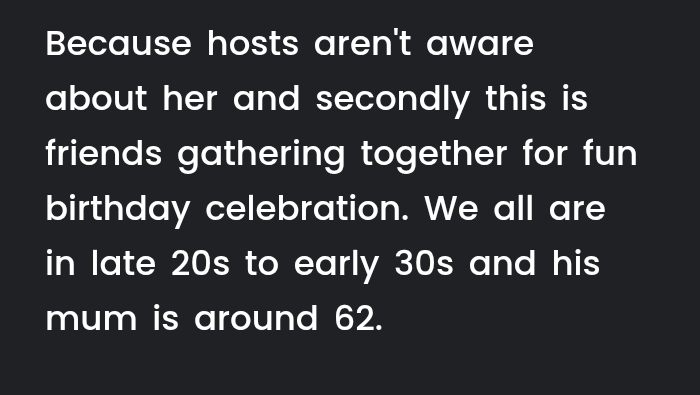
The wife also explained that her mother-in-law was around 62, while the friends and their partners were mostly in their late 20s and early 30s. She also mentioned that her mother-in-law came from a different culture and did not speak the language well.
These differences could potentially make the gathering uncomfortable for the mother-in-law, especially if most of the conversation involved people she had never met.
However, this is not necessarily the strongest part of the wife’s argument. Someone being older or from another culture does not automatically mean they would not enjoy a younger social gathering. The more straightforward issue remains that she was not included on the original invitation.
6. The Disagreement Escalated
When the husband remained determined to bring his mother, the wife said she would not attend if he went ahead with the plan.
This understandably made the disagreement more serious. From the wife’s perspective, she did not want to participate in something she believed could make the hosts uncomfortable. From the husband’s perspective, however, her refusal may have sounded like an ultimatum.
There is therefore room to criticize the way the disagreement was handled even if the wife’s underlying concern was reasonable.
7. The Mother-in-Law Was Not Presented as the Problem
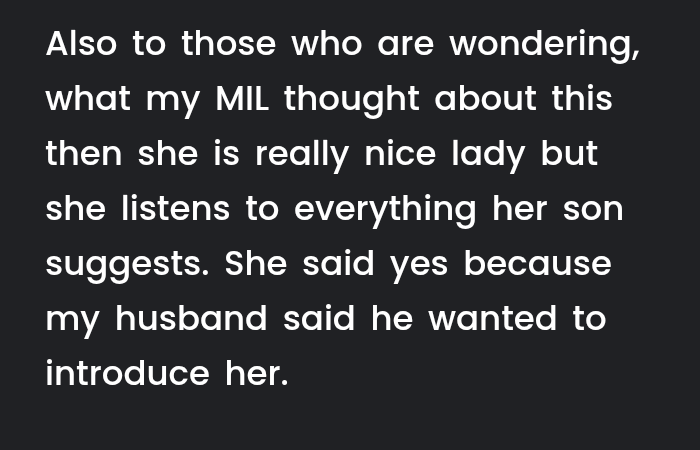
One of the most important details from the update is that the wife actually speaks positively about her mother-in-law.
She describes her as a really nice woman and says that she loves her. She even explains that she would have liked to introduce her to their friends.
That makes it much harder to argue that the wife was simply looking for an excuse to exclude her mother-in-law. Her objection appears to have been about the specific occasion rather than the person.
8. The Mother-in-Law Apparently Did Not Demand to Attend
According to the wife, her mother-in-law agreed to go because her son told her that he wanted to introduce her to his friends.
This suggests that the mother-in-law herself may not have realized there was a potential etiquette issue. She was apparently following her son’s suggestion rather than demanding that she be included.
As a result, the responsibility for the decision appears to fall primarily on the husband rather than his mother.
9. The Wife Did Not Want to Put the Hosts on the Spot
The update reveals that the wife eventually thought more carefully about contacting the birthday hosts directly.
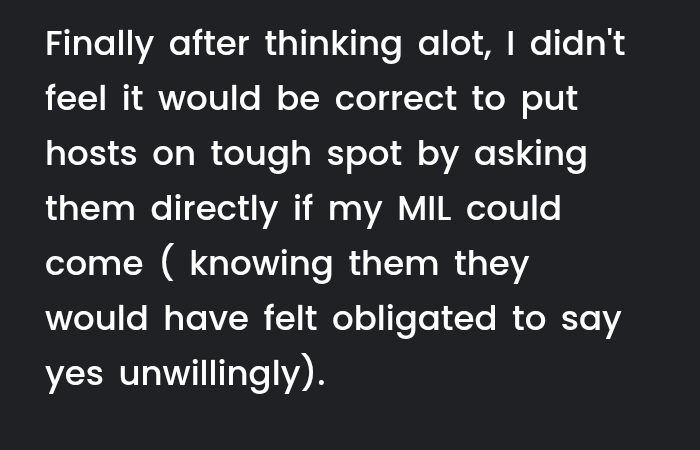
She felt that asking them whether her mother-in-law could attend might place them in an uncomfortable position. Even if they preferred to keep the gathering limited to the original group, they might feel obligated to say yes simply to avoid offending the couple.
This was an important consideration because a host should ideally be able to make a genuine choice about who attends their own event.
10. She Asked Another Invited Friend for Advice
Instead of immediately contacting the hosts, the wife asked another friend who was also invited to the birthday gathering.
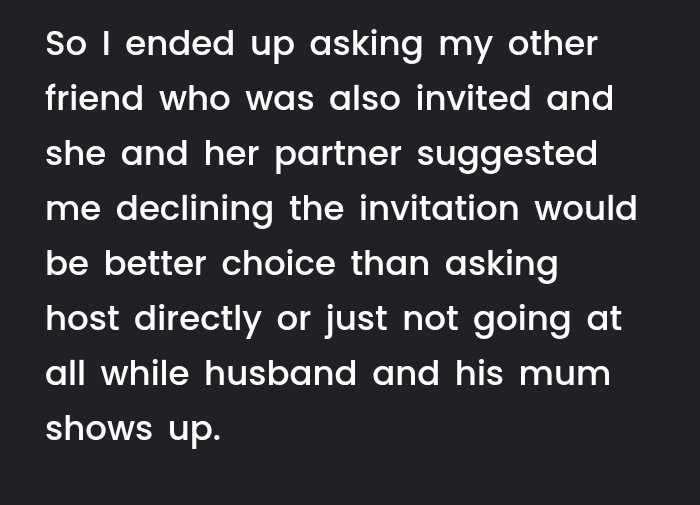
That friend and her partner suggested that declining the invitation would be better than asking the hosts to accommodate an unexpected guest or having the husband and his mother simply show up.
This gave the couple another option that kept the hosts out of the disagreement.
11. The Couple Ultimately Declined the Invitation
After thinking about the situation, the wife asked her husband to inform the hosts that they would not be able to attend.
The husband apparently made a fuss about it for a while, but eventually sent the message.
This was not necessarily the perfect outcome for either spouse, but it prevented the hosts from being placed in the middle of their disagreement.
12. The Husband’s Feelings Were Still Understandable
It is important to acknowledge why the husband was upset.
He wanted his visiting mother to feel included, and he likely saw introducing her to his friends as a positive family moment. From his perspective, his wife’s refusal may have seemed unnecessarily strict.
Wanting to include a parent is not unreasonable. The problem was that his desire to include her did not automatically give him the authority to add another person to someone else’s private gathering.
13. The Wife Could Have Handled the Initial Conversation Better
Although the wife’s concern was understandable, her initial response could arguably have been more diplomatic.
Instead of immediately saying that she would not attend if her husband brought his mother, she could have suggested that they contact the hosts together and give them an easy opportunity to decline.
Alternatively, the couple could have discussed another way for the husband to introduce his mother to their friends on a different occasion.
Her later decision to decline the invitation was more diplomatic because it avoided making the hosts responsible for resolving the couple’s disagreement.
14. The Husband Could Also Have Been More Considerate
The husband could have recognized that an invitation is controlled by the hosts, not by the guests.
Even if he believed his friends would not mind, assuming they would be happy to accommodate an unexpected guest was risky. A simple message asking permission would have eliminated much of the uncertainty.
The fact that the wife ultimately worried that even asking might pressure the hosts demonstrates why the issue was more complicated than simply saying, “It’s only one extra person.”
15. The Final Solution Avoided an Awkward Situation
Ultimately, neither spouse got exactly what they initially wanted.
The husband did not get to introduce his mother to their friends at the birthday lunch, and the wife did not attend the celebration as originally planned. However, the final decision ensured that the hosts were not forced to deal with an unexpected guest or referee a disagreement between the couple.
It was an imperfect compromise, but it kept the issue between the husband and wife rather than turning their friends’ birthday celebration into part of the conflict.
Overall Assessment
The wife’s concern appears reasonable because the mother-in-law was not part of the original invitation and the gathering was described as a relatively small event for a specific group of friends and partners. The husband had a perfectly understandable reason for wanting his mother included, but the more appropriate approach would have been to obtain the hosts’ permission before making that decision.
At the same time, the wife could have communicated her position more gently and worked with her husband toward a solution instead of making her attendance conditional on his choice. Her later decision to decline the invitation rather than pressure the hosts was considerably more diplomatic and reinforces her claim that the issue was about respecting the hosts rather than rejecting her mother-in-law.
Ultimately, the disagreement was less about the mother-in-law herself and more about who gets to control the guest list. The husband wanted to include his mother in an important part of his social life, while the wife wanted to respect the boundaries of the people who organized the event. The final decision was not ideal for either spouse, but it avoided putting the birthday hosts in an awkward position.