

After years of watching intimacy slowly disappear from his relationship, one young man found himself relying on masturbati*n instead of waiting for a s*x life that rarely existed anymore.
But when his girlfriend unexpectedly initiated intimacy after he returned from a two-month trip, his brutally honest response—that he’d rather rely on masturbati*n than have s*x—left her devastated.
Hence, raising difficult questions about rejection, communication, unmet emotional needs, and the lasting impact of a relationship where physical intimacy had faded over time.
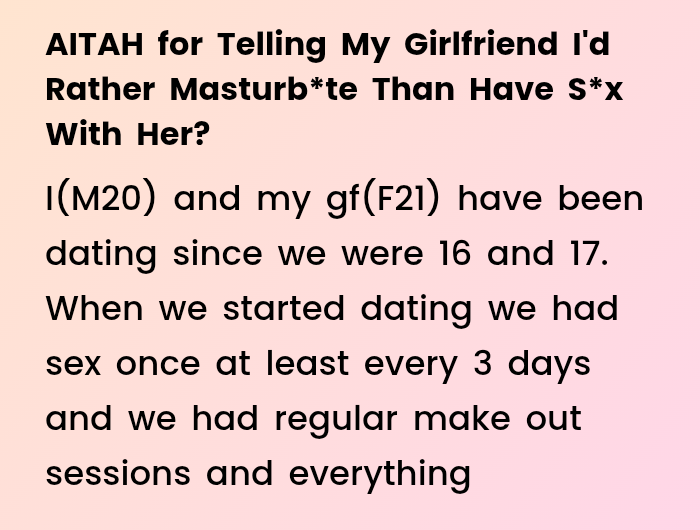



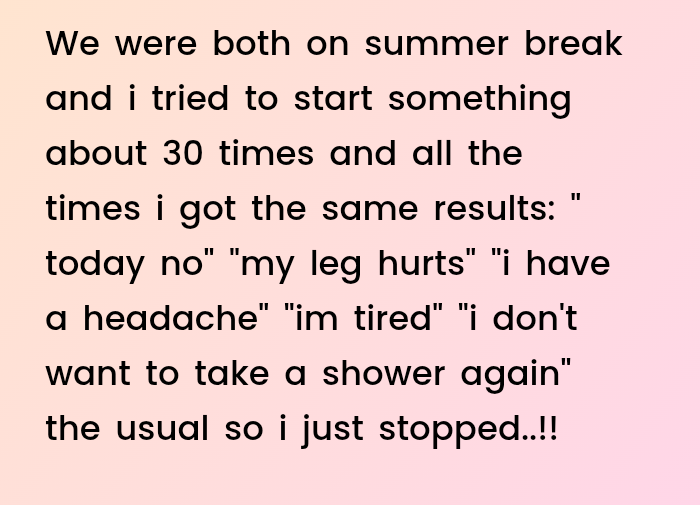









One of the most striking aspects of this story is how dramatically the relationship evolved over the years.
At the beginning, the couple shared a healthy and active s*x life, enjoyed spending time together, and seemed physically and emotionally connected.
Like many young couples, they naturally expressed affection through intimacy, and there appeared to be a balance that made both partners feel close.
Check The Comment Section Below
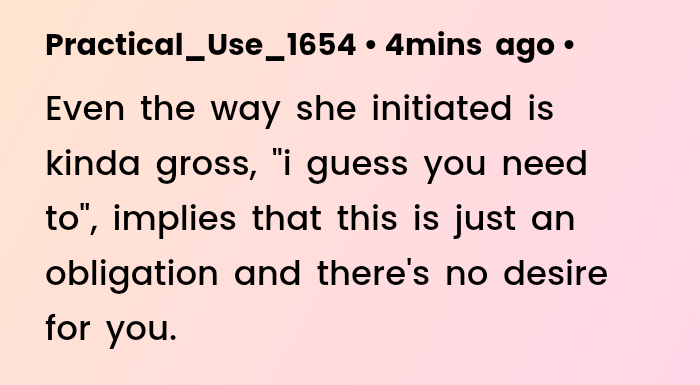
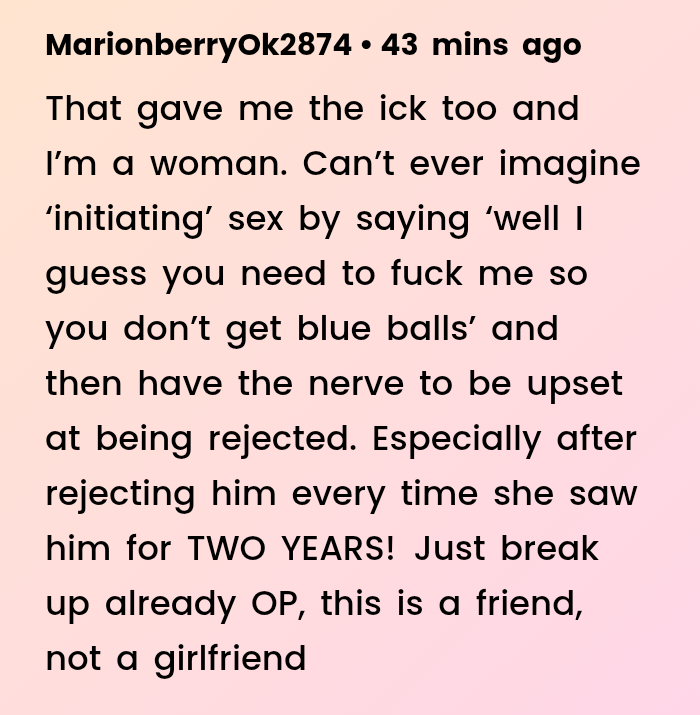
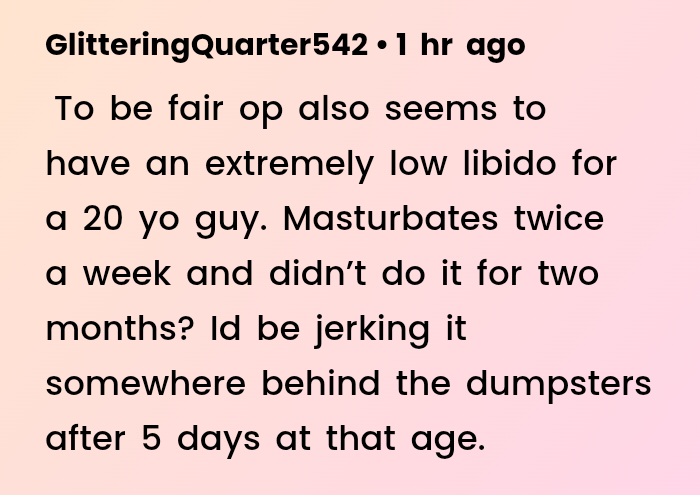
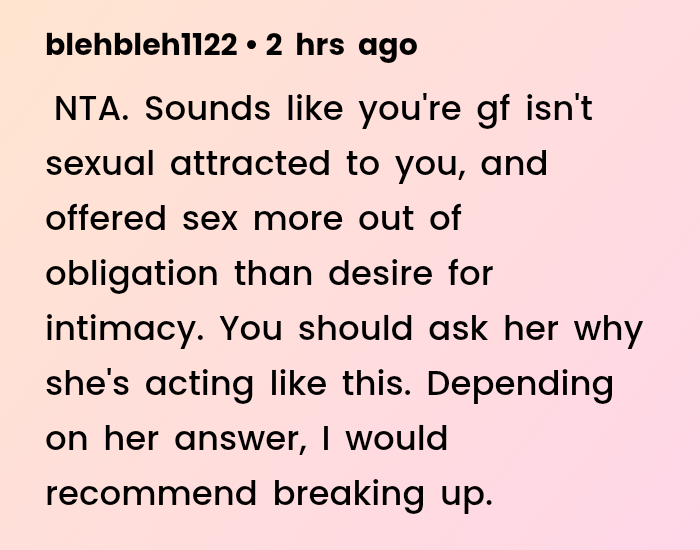
Analysis
A Relationship That Changed Over Time
Relationships rarely remain exactly the same forever. As time passed, the frequency of intimacy gradually declined. At first, it wasn’t a major concern because they still shared affection in other ways, and the writer respected his girlfriend’s boundaries whenever she wasn’t interested. Instead of becoming angry or demanding, he accepted her answers and tried to be understanding. This gradual shift set the stage for a much larger emotional issue that neither partner fully addressed.
Long-Distance Relationships Often Create New Challenges
The beginning of university introduced another layer of difficulty. Living in different cities meant that opportunities for physical closeness became much less frequent. Long-distance relationships require an enormous amount of communication, trust, and intentional effort because everyday moments together become limited.
Even though the couple continued visiting each other, going on dates, and staying emotionally connected, physical intimacy became increasingly rare. Distance alone doesn’t necessarily end intimacy, but when it combines with declining desire, busy schedules, and changing priorities, it can create emotional gaps that quietly grow over time.
Many couples underestimate how much distance can affect not only physical connection but also emotional closeness if difficult conversations are avoided.
Respecting “No” Is an Important Part of Any Relationship
One detail that deserves recognition is the writer’s response to repeated rejection.
Throughout the story, he describes initiating intimacy many times only to receive reasons such as being tired, having a headache, sore legs, or simply not wanting to. Rather than arguing, pressuring, or trying to convince his girlfriend otherwise, he accepted her decisions.
Healthy relationships depend on respecting consent.
“No” should always be accepted without guilt or pressure.
At the same time, repeatedly saying no over a long period without discussing the reasons can create emotional distance. Respecting a partner’s boundaries and honestly discussing unmet needs are both important. One does not replace the other.
Unmet Needs Don’t Simply Disappear
As physical intimacy disappeared, the writer found another way to manage his own needs through masturbati*n.
This is where many readers may misunderstand the story.
His choice wasn’t presented as replacing his girlfriend out of preference from the beginning. Instead, it became a coping mechanism after years of infrequent intimacy.
When someone’s emotional or physical needs remain unmet for a long time, people naturally adapt. Some focus more on hobbies, work, exercise, or friendships. Others rely on masturbati*n as a private way to relieve physical tension without placing pressure on their partner.
That doesn’t necessarily mean they love their partner any less.
It often reflects adaptation rather than rejection.
Returning Home Carried Different Expectations
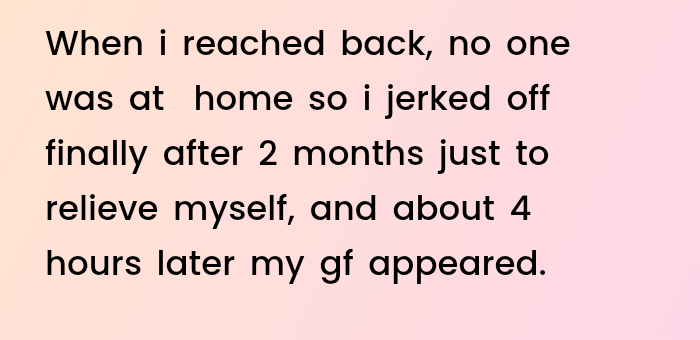
One of the biggest turning points occurs when the writer returns home after spending two months abroad.
Because he had little privacy during that time, he hadn’t engaged in masturbati*n either.
After arriving home exhausted from traveling and finally having privacy again, he chose to relieve himself.
Several hours later, his girlfriend arrived.
From his perspective, nothing unusual had happened.
From her perspective, however, she likely imagined an emotional reunion where physical intimacy would naturally follow.
Both entered that moment carrying completely different expectations without realizing it.
Misunderstandings often begin exactly this way—not because either person intended harm, but because neither understood what the other was expecting.
One Honest Answer Changed Everything
The emotional heart of the story arrives during one simple question.
His girlfriend asked whether he would rather have s*x with her or choose masturbati*n.
Without thinking, he answered honestly.
Sometimes complete honesty can still cause enormous pain.
His response likely reflected years of disappointment, emotional adjustment, and lowered expectations rather than a lack of love.
Unfortunately, his girlfriend heard something entirely different.
She didn’t hear:
“I’ve adapted because our intimacy disappeared.”
She heard:
“I don’t want you anymore.”
Those are two very different messages.
This misunderstanding explains why she immediately became emotional.
Why His Girlfriend’s Reaction Makes Sense
Although many readers sympathize with the writer after years of rejection, it’s also important to understand why his girlfriend reacted so strongly.
For many people, hearing that their partner prefers masturbati*n over being intimate with them can trigger feelings of insecurity, rejection, and self-doubt.
She immediately questioned whether he still loved her.
That question suggests her emotional response wasn’t only about s*x.
It was about feeling wanted.
Feeling desired by a romantic partner often carries deep emotional significance.
When that reassurance suddenly disappears, fear naturally follows.
Years of Rejection Also Leave Emotional Scars
At the same time, the writer’s feelings deserve equal compassion.
Repeated rejection can quietly affect someone’s confidence over months and years.
Eventually, many people stop initiating altogether—not because they stop caring, but because protecting themselves from repeated disappointment becomes emotionally easier.
After enough time passes, routines change.
Expectations disappear.
People adapt to a relationship that functions differently than it once did.
His answer may have sounded harsh, but it also reflected years of emotional adjustment that had never been openly discussed.
Communication Was Missing Long Before This Conversation
One of the biggest lessons from this story is that the relationship needed honest communication much earlier.
Rather than discussing why intimacy had disappeared, what each partner was feeling, or whether something needed to change, both seemed to adapt in different ways.
She became accustomed to rarely being intimate.
He became accustomed to relying on masturbati*n.
Neither approach actually solved the underlying problem.
Difficult conversations can feel uncomfortable, but avoiding them often allows small issues to grow into relationship-changing conflicts.
Intimacy Is About More Than Physical Release
It’s easy to assume this story is simply about s*x, but the deeper issue is emotional connection.
Physical intimacy often represents affection, reassurance, vulnerability, and closeness.
When it disappears, partners sometimes begin questioning whether they are still attractive, appreciated, or emotionally important.
Likewise, choosing masturbati*n wasn’t necessarily about physical pleasure alone.
It represented predictability.
It required no rejection.
No disappointment.
No uncertainty.
That emotional safety became part of the habit.
Society Rarely Talks About These Situations Honestly
Many couples quietly experience mismatched levels of desire, yet very few discuss it openly.
People often feel embarrassed admitting they feel unwanted.
Others feel guilty admitting they have lost interest in intimacy.
As a result, countless couples silently struggle instead of seeking understanding or professional guidance.
There is no shame in discussing relationship challenges. Honest conversations, counseling, or speaking with a healthcare professional can often uncover emotional, psychological, or medical factors contributing to changes in intimacy.
Healing Requires Understanding Both Perspectives
Neither partner appears to have intended to hurt the other.
The girlfriend may not have realized how years of rejection affected her partner emotionally.
The writer may not have realized how deeply his honest answer would wound someone who was suddenly trying to reconnect.
Healing would require both people to move beyond the single conversation and examine everything that led up to it.
Understanding is often more valuable than deciding who was “right.”
Final Thoughts
This story reminds us that relationships rarely break down because of one sentence alone. The heartbreaking conversation was simply the moment when years of unmet expectations, declining intimacy, unspoken frustrations, and emotional distance finally surfaced. While the writer respected his girlfriend’s boundaries and adapted through masturbati*n, his girlfriend was left devastated by hearing that he no longer viewed s*x with her as his first choice. Both experiences are emotionally valid because both partners were carrying unseen pain.
The hopeful message is that situations like this don’t have to be the end of a relationship. Honest communication, empathy, and a willingness to understand each other’s experiences can sometimes repair damage that has built up over years. Whether they ultimately stay together or not, this story highlights the importance of talking openly about intimacy, emotional needs, and expectations before silence turns into resentment and honest answers become painful surprises.